Business VoIP Guide


Introduction: Business Communication Has Changed
For decades, organizations relied on traditional phone carriers, copper lines, and fixed desk phones to run their communications.
Today, business communication no longer depends on physical lines. Companies now operate across offices, remote environments, mobile teams, and hybrid workspaces — and traditional phone systems struggle to keep up.
This is why organizations across industries are transitioning to VoIP (Voice over Internet Protocol) systems.
What Is VoIP?
VoIP allows phone calls to be transmitted over an internet connection instead of traditional telephone lines.
Instead of:
Physical line → phone company → building
The path becomes:
Internet → secure cloud phone system → user device
Employees can make and receive calls using:
- Desk phones
- Laptops
- Mobile devices
- Softphone apps
VoIP turns communication into software rather than infrastructure.
Why Businesses Are Replacing Traditional Phone Systems
Rising Costs
Traditional carriers often charge for:
- Line access
- Long distance
- Hardware maintenance
- On-site service calls
- Contract changes
VoIP consolidates these into predictable monthly service pricing.
Limited Flexibility
Traditional systems restrict users to physical locations.
VoIP enables:
- Remote employees
- Multiple offices
- Mobile teams
- Business continuity during outages
Maintenance Challenges
Legacy PBX systems require:
- Specialized technicians
- Expensive parts
- Downtime during changes
VoIP platforms update automatically without hardware replacements.
Core Benefits of Business VoIP
1. Cost Reduction
Organizations often reduce telecom expenses by eliminating legacy infrastructure and carrier fees.
2. Mobility
Employees can answer business calls anywhere with secure access.
3. Reliability
Cloud redundancy keeps systems operating even during local outages.
4. Scalability
Adding or removing users takes minutes instead of hardware installs.
5. Integration
VoIP integrates with CRM platforms, ticketing systems, and collaboration tools.
Key Features Companies Gain With VoIP
Modern business VoIP platforms include:
- Auto attendants
- Call routing rules
- Voicemail to email
- Mobile and desktop apps
- Call analytics and reporting
- Call recording
- Conference calling
- SMS messaging
- Presence indicators
- Disaster recovery routing
Instead of a phone system, businesses gain a communication platform.
VoIP vs Traditional Phone Service
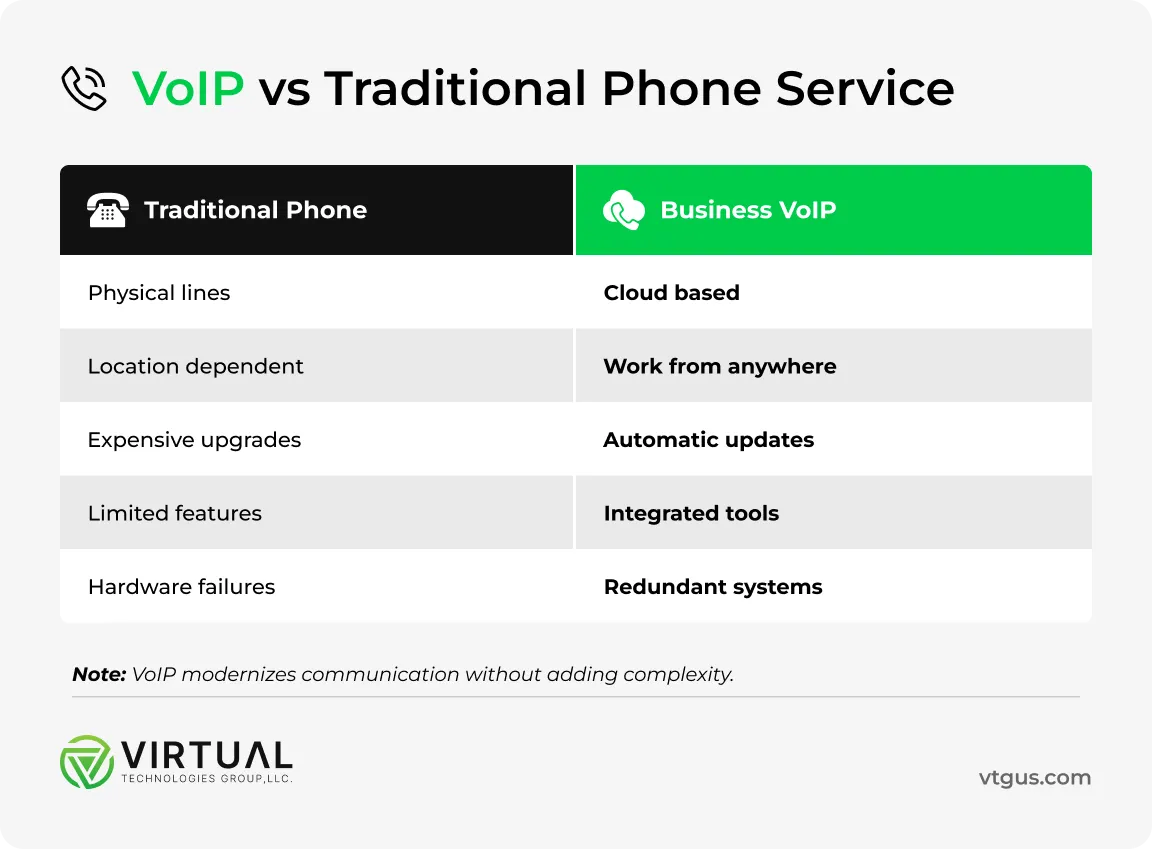
Why Companies Are Switching in 2026
Organizations are prioritizing:
- Hybrid workforce support
- Predictable operating costs
- Business continuity
- Centralized communication platforms
- IT-managed infrastructure
VoIP aligns communication with modern operations instead of legacy telecom models.
Upcoming Webinar: See If You Can Lower Your Phone Costs
VTG is hosting a live session explaining how organizations are reducing communication expenses while improving reliability.
Bring your current phone and internet bill and the team will evaluate whether your organization can reduce costs or improve service.
👉 Subscribe to the webinar here
The session covers:
- Identifying hidden telecom costs
- Comparing carrier vs hosted systems
- Migration considerations
- Real-world business scenarios
Conclusion
VoIP transforms communication from a fixed utility into a flexible business platform. Companies gain reliability, mobility, and scalability while simplifying management and reducing cost complexity.
As organizations modernize infrastructure, communication systems are often one of the first areas to benefit.
Subscribe to our newsletter
Bring your skills, your passion, and your goals - we’ll provide the platform to thrive.

Stay Ahead with VTG Insights