What Enterprise IT Infrastructure Actually Looks Like in 202


Introduction: IT Is No Longer a Support Function
For many years, IT was treated as a reactive support function — resolving tickets, managing devices, and maintaining systems as needed.
In 2026, that model no longer supports growing organizations.
Today, IT infrastructure is directly tied to:
- Operational performance
- Revenue continuity
- Cybersecurity risk
- Scalability
Enterprise organizations are shifting toward structured, proactive IT environments designed to support long-term growth.
Always-On Monitoring and Visibility
Modern enterprise IT environments rely on continuous monitoring across systems.
This includes:
- Network performance
- Endpoint activity
- System health
- Unusual behavior detection
Rather than waiting for issues to occur, organizations identify and address problems before they impact operations.
Visibility becomes a core requirement, not an optional enhancement.
Security Built Into Every Layer
Security is no longer a standalone function — it is embedded throughout the entire infrastructure.
This includes:
- Identity and access controls
- Endpoint protection
- Network segmentation
- Data encryption
- Continuous threat monitoring
Enterprise environments treat security as part of system design, not an afterthought.
Standardization Across Systems
One of the defining characteristics of enterprise IT is consistency.
Leading organizations standardize:
- Hardware configurations
- Software environments
- Security policies
- Deployment processes
Standardization reduces complexity, improves efficiency, and makes systems easier to manage at scale.
Cloud-Centric Architecture
Enterprise IT environments increasingly rely on cloud infrastructure.
This allows organizations to:
- Scale resources quickly
- Support remote and hybrid workforces
- Reduce dependency on physical infrastructure
- Improve redundancy and availability
Cloud environments also enable more flexible system integration across departments.
Automation and Reduced Manual Work
Manual processes create inefficiencies and increase the likelihood of errors.
Enterprise IT infrastructure incorporates automation for:
- System updates
- Monitoring alerts
- User provisioning
- Backup processes
- Routine maintenance
Automation allows teams to focus on strategic initiatives rather than repetitive tasks.
Vendor Consolidation and Integration
Growing organizations often accumulate multiple vendors and disconnected systems over time.
Enterprise IT strategies focus on:
- Consolidating vendors
- Integrating platforms
- Reducing redundancy
- Improving data flow across systems
This creates a more efficient and manageable environment.
Built for Scalability
Perhaps the most important characteristic of enterprise IT is scalability.
Infrastructure is designed to support:
- Rapid employee growth
- New locations
- Increased system usage
- Evolving business needs
Rather than reacting to growth, enterprise environments are built to accommodate it.
From Reactive to Proactive IT
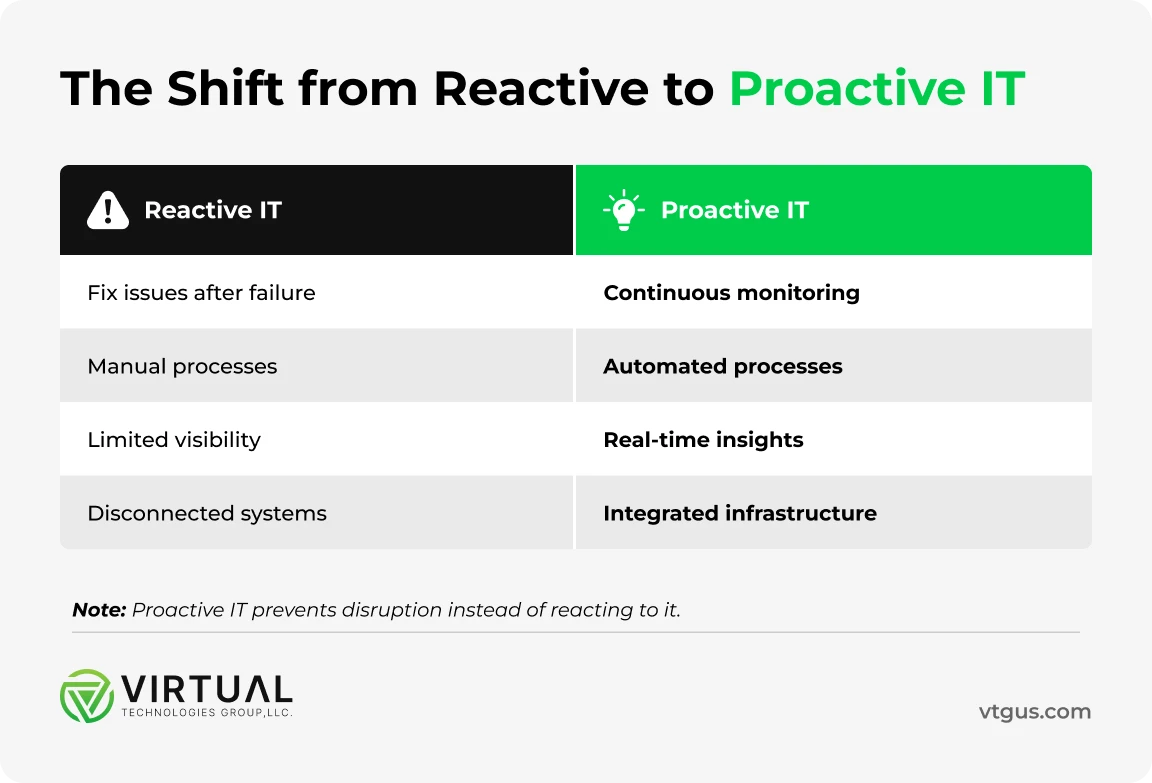
The shift to enterprise IT is ultimately a shift in mindset.
Instead of responding to problems, organizations:
- Anticipate risks
- Plan infrastructure upgrades
- Monitor systems continuously
- Align IT with business strategy
This proactive approach reduces downtime and supports long-term growth.
Preparing for Enterprise-Level IT
Many organizations recognize the need to modernize but are unsure where to begin.
Understanding what enterprise IT infrastructure looks like is the first step toward identifying gaps in current systems.
Webinar Callout
If your organization is evaluating how IT infrastructure should evolve to support growth, this conversation continues in our upcoming session.
Join VTG’s Enterprise IT Webinar on May 7
We’ll walk through:
- How to evaluate your current environment
- Common infrastructure gaps
- Strategies for building scalable IT systems
Conclusion
Enterprise IT infrastructure in 2026 is defined by proactive management, integrated security, and scalable design. Organizations that adopt this model position themselves to grow efficiently while reducing operational risk.
Understanding this standard helps leaders evaluate whether their current environment is built for the future.
Subscribe to our newsletter
Bring your skills, your passion, and your goals - we’ll provide the platform to thrive.

Stay Ahead with VTG Insights